
Wunderbridge Insights · Report
Sector analysis and strategic implications for universities and colleges.
The Institutional Brand Dividend
How sustained brand and creative investment compounds value for universities and colleges
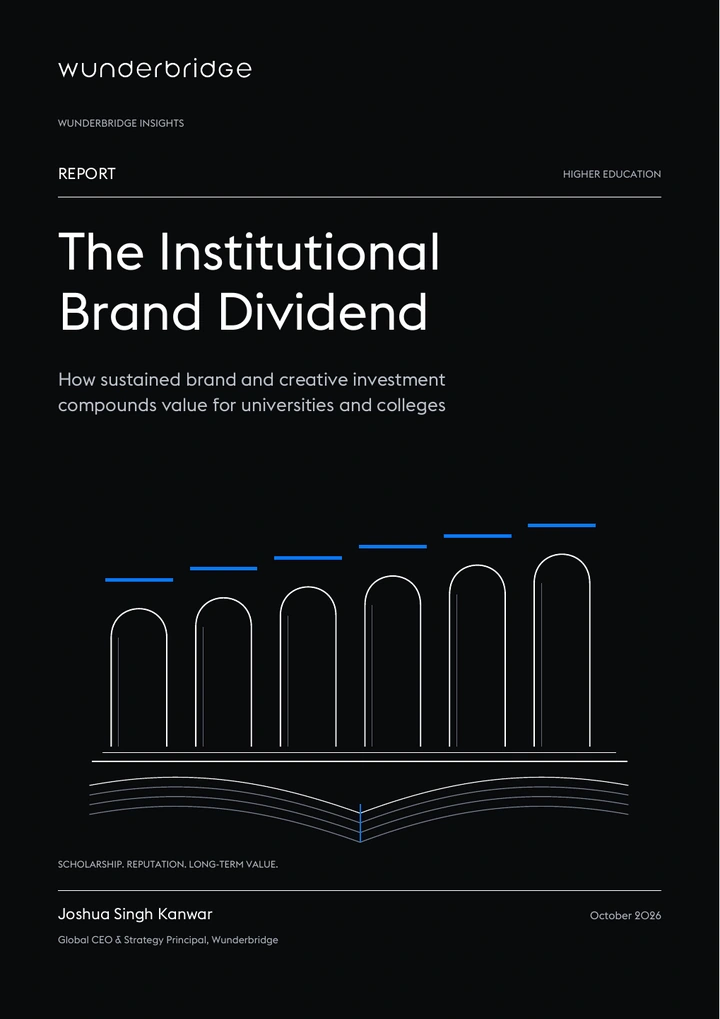
Brand is not the campaign around the institution.
It is the meaning the institution earns over time.
The Institutional Brand Dividend examines why universities and colleges should treat brand as long-term institutional infrastructure rather than a short-term admissions expense.
Drawing on sector data, peer-reviewed scholarship and original strategic analysis, Joshua Singh Kanwar argues that a clear promise—repeated, evidenced and experienced across years—can strengthen preference, participation, philanthropy, partnership and resilience.
The report does not claim that branding alone causes enrolment or financial performance. It proposes a disciplined way to connect institutional meaning, creative distinctiveness, lived experience and evidence.
Executive position
The same institutional asset can influence many consequential decisions.
Brand compounds when a clear institutional promise is repeated, evidenced and experienced across years.
The proposition
Academic substance without recognisable meaning is under-valued. Creative distinctiveness without academic substance is theatre. The strategic task is to connect mission, offer, experience and evidence in a system people can remember and believe.
This report is an evidence-led strategic synthesis. Its original frameworks should be tested against an institution’s own audiences, operating model and financial structure.
01 / The environment
The market is not simply crowded. It is structurally unforgiving.
Institutions are competing for attention, confidence and participation across more audiences at once.
Spring 2026 US postsecondary enrolment reached 18.6 million, up 1.0% year on year, but performance varied sharply by sector and programme. Private nonprofit four-year enrolment was essentially flat, while undergraduate certificates grew fastest.1 The implication is not universal contraction. It is uneven demand, requiring institutions to be clearer about where they create distinctive value.
International recruitment adds scale and volatility. US institutions hosted 1.18 million international students in 2024–25, but new international enrolment fell 7%; a fall 2025 snapshot later reported a 17% decline in new international students among participating institutions.6 Brand cannot remove policy or mobility risk, but it can improve how an institution is recognised, trusted and chosen across borders.
India presents a different challenge of scale. The Ministry of Education reported 1,213 universities and 46,624 colleges listed for 2022–23, with a higher-education gross enrolment ratio of 29.5.11 Expansion creates opportunity and a dense field competing for faculty, students, partners and public legitimacy.
NACUBO’s latest tuition-discounting study illustrates the cost pressure in the US private nonprofit sector: institutions awarded roughly 57 cents in grant aid for every dollar of published tuition and fees for first-time undergraduates in 2025–26.2 Financial aid serves access and mission; the risk is using price as the default substitute for distinctive value.
When every institution claims excellence, innovation, belonging and outcomes, the category becomes fluent but forgettable.
02 / What brand means
Institutional meaning, made coherent.
A useful university brand is not a logo, campaign line or admissions toolkit.
What the institution chooses to stand for and how it defines its role.
What stakeholders believe, based on evidence and accumulated experience.
How meaning becomes distinctive, recognisable and usable across touchpoints.
Where the promise is confirmed—or contradicted—in teaching, service and community.
A 2023 systematic review of 43 university-brand studies found recurring attention to identity, positioning, students, staff and institutional management rather than promotion alone.7 Other research has linked brand equity and service quality with reputation and intention to choose, while recognising that university choice is multifactorial.8
The correct unit of design is the institution itself. That does not mean communications should control academics or operations. It means leaders should define a small number of durable commitments, then give faculties, admissions, advancement and student services a common strategic language for expressing and fulfilling them.
03 / The value system
Six dividends from one institutional asset.
The case for sustained investment is strongest when brand is managed across the whole value system.
- 01Preference
More qualified consideration, better fit and stronger yield among priority audiences.
- 02Price confidence
A clearer account of value that complements aid strategy and reduces dependence on undirected discounting.
- 03Participation
Greater student, staff and alumni identification with a mission they can recognise and enact.
- 04Philanthropy
A coherent case for support, connecting donor intent to visible institutional priorities and proof.
- 05Partnership
A more legible proposition for employers, governments, researchers and international collaborators.
- 06Resilience
A stock of earned meaning that helps stakeholders interpret change, challenge and crisis.
A study of 1,000 alumni associated university brand image with positive word-of-mouth through satisfaction and identification.9 Separate research with 791 alumni found that recalled academic and social experiences influenced identification, which predicted loyalty and support.10 These studies do not prove a universal financial multiplier; they show why value cannot be reduced to the next admissions cycle.
04 / Original framework
The institutional brand compounding loop.
Value grows when meaning survives repeated contact and becomes easier to retrieve, trust and advocate.
- 01Meaning
A distinctive role, expressed in language stakeholders can understand.
- 02Memory
Consistent creative assets make that meaning easier to recognise and recall.
- 03Proof
Outcomes, research, student experience and external evidence make the promise credible.
- 04Preference
The institution becomes a more confident choice at a consequential decision point.
- 05Participation
Students, faculty, alumni and partners reinforce the meaning through behaviour.
- 06Advocacy
Trusted voices extend reach and return new evidence to the institution.
Time is the multiplier. A distinctive platform used for seven years can accumulate recognition, shared language, stories and proof. A platform replaced every 18 months repeatedly pays the cost of explanation while discarding memory.
Build once. Improve continuously. Distribute widely. Measure over time.
05 / Creative strategy
Make the institution memorable without making it shallow.
The strongest higher-education creative systems reveal intellectual character rather than imitate the category.
Most university communications are individually competent and collectively indistinct. They borrow the same stock scenes, vocabulary and visual codes. Distinctiveness begins with an intellectual decision: what pattern of ideas, place, pedagogy, research or public purpose should this institution make unmistakably its own?
Creative strategy must translate that decision into assets that accumulate memory—language, symbols, image behaviour, editorial formats, events and digital experiences—while leaving room for real academic plurality.
In Carnegie’s May 2025 survey of more than 3,400 prospective students and parents, graduating seniors identified college websites as their leading source of college information (64%), ahead of search engines (49%) and family (45%).3 The website is therefore not a brochure repository. It is a consequential institutional experience.
Good branding does not make every university look premium. It makes each university more recognisably itself.
06 / Operating model
Fund a capability, not a launch event.
Long-term value requires governance, evidence and creative renewal after the identity launch.
| Investment | Role | What it funds |
|---|---|---|
| 25% | Strategy & research | Audience evidence, positioning, portfolio logic, market and reputation tracking. |
| 30% | Creative system | Identity, language, flagship expression, templates and scalable faculty toolkits. |
| 30% | Experience & content | Priority journeys, evidence platforms, stories, admissions and advancement experiences. |
| 15% | Stewardship | Training, measurement, refresh, evidence management and internal adoption. |
The percentages are a planning heuristic, not an external benchmark. Governance should be federated: a central brand office owns the platform, evidence rules and core assets; schools receive enough freedom to express genuine academic difference within that architecture.
Internal adoption is not a communications exercise. If the people delivering the experience do not understand the promise, external consistency will be cosmetic.
07 / Measurement
Measure the value chain, not the volume of activity.
A credible dashboard links leading indicators to institutional outcomes without pretending correlation is causation.
| Layer | Signals | Decision |
|---|---|---|
| Meaning | Awareness, associations, distinctiveness, comprehension | Is the intended position entering memory? |
| Demand | Qualified enquiries, application mix, yield, search demand | Are priority audiences choosing to know more? |
| Experience | Retention, belonging, service quality, recommendation | Is the promise being experienced? |
| Advancement | Alumni engagement, donor renewal, gift mix | Is affinity becoming participation? |
| Institution | Net tuition revenue, talent, partnerships, research opportunity | Is the institution gaining durable options? |
CASE’s brand and reputation metrics framework similarly spans brand development, recruitment and retention, strategic communications, alumni engagement, philanthropy and external engagement.12 Establish baselines before major change; segment by audience and market; use comparable definitions across years; and pair behavioural data with qualitative evidence.
The board should see whether institutional meaning is strengthening, whether experience supports it and where financial or reputational outcomes are plausibly connected.
08 / Investment horizon
A five-year institutional brand programme.
Sequence the work so recognition, evidence and capability accumulate instead of resetting.
- Year 01Choose and build
Define the position, resolve portfolio confusion, create the identity system, baseline perception and fix priority journeys.
- Year 02Prove and distribute
Publish flagship evidence, equip faculties, redesign admissions and advancement content, and build distinctive memory.
- Year 03Embed and extend
Connect experience standards, partnerships, research communications and international markets to the platform.
- Year 04Optimise and deepen
Use longitudinal evidence to improve audience journeys, programme narratives and creative effectiveness.
- Year 05Renew without resetting
Refresh expression, retain recognisable assets, review strategic relevance and recommit resources.
The model should not force every institution into the same spend curve. A regional college may focus on one high-value audience journey and a small number of distinctive assets. A global university may need a federated system operating across schools, languages and countries.
Every year should add an asset the next year can use.
Conclusion
Build an institution people can recognise, believe and join.
The financial return from brand is rarely a clean line. The institutional return can still be profound.
Universities and colleges operate through long relationships: years of study, decades of alumni identity, research partnerships, public trust and philanthropic commitment. A short-term communications model is poorly matched to that reality.
Sustained brand and creative investment can create outsized value because the same asset influences multiple decisions over time. A clear promise can help a student recognise fit, a faculty member understand ambition, an employer see relevance, an alumnus sustain identification and a donor understand what their support can make possible.
Five questions for university leadership
- 01What should this institution be known for?
And among which priority audiences?
- 02What proves the promise?
Identify the parts of the student and alumni experience that make it credible.
- 03Which assets will we protect for five years?
Memory cannot compound when the system constantly resets.
- 04Where are we compensating for weak meaning?
Look for excess dependence on price, media or rankings.
- 05What evidence will show progress?
Track whether preference and participation are compounding.
Creative strategy makes an institution easier to remember; it cannot compensate indefinitely for an institution that does not deliver.
Research transparency
Sources & method.
This publication is an attributed synthesis of public sector data, institutional research and peer-reviewed scholarship, combined with original strategic interpretation by Joshua Singh Kanwar. It is not a primary empirical study. Findings from specific countries, institutions and samples are not presented as universal causal estimates.
- National Student Clearinghouse Research Center, “Final Spring Enrollment Trends 2026,” 4 June 2026.
- NACUBO, “Most Undergraduates Receive Grants at Private Colleges,” 1 June 2026; 2025 Tuition Discounting Study, n=258 institutions.
- Carnegie, “Research on What Drives College Choice,” May 2025 survey of more than 3,400 prospective students and parents.
- Gallup, “U.S. Public Trust in Higher Ed Rises From Recent Low,” 15 July 2025, n=1,402 US adults.
- CASE, “Insights on Voluntary Support of Education 2025,” 14 April 2026, 670 participating US institutions.
- Institute of International Education, “Open Doors 2025,” 17 November 2025.
- Xiao et al., “University brand: A systematic literature review,” Heliyon 9(6), 2023; 43 articles; DOI 10.1016/j.heliyon.2023.e16825.
- Rizard, Waluyo and Jaswir, “Impact of brand equity and service quality on the reputation of universities and students’ intention to choose them,” F1000Research; DOI 10.12688/f1000research.122386.3.
- Schlesinger, Cervera-Taulet and Wymer, “The influence of university brand image, satisfaction, and university identification on alumni WOM intentions,” Journal of Marketing for Higher Education 33(1), n=1,000.
- Palmer, Koenig-Lewis and Asaad, “Brand identification in higher education: a conditional process analysis,” Journal of Business Research 69(8), n=791.
- Government of India, Ministry of Education, Annual Report 2024–25, higher-education enrolment and institutional statistics for 2022–23.
- CASE, “A Framework for Brand and Reputation Metrics in Education,” 2024.
About the author. Joshua Singh Kanwar writes on strategy, creative leadership, technology and durable institutional value. Published by Wunderbridge, an independent global brand accelerator.